
Heads up: we may earn a commission when you buy through links on this page, at no extra cost to you. As an Amazon Associate we earn from qualifying purchases. How we make money
Short on time? Our top pick is Lenovo ThinkPad T14 Gen 6, Dell XPS 13 9350 takes Best Compact Pick, while Apple MacBook Air 15 M5 takes Best Big Screen Pick.
- Best Overall Lenovo ThinkPad T14 Gen 6 Check price
- Best Compact Pick Dell XPS 13 9350 Check price
- Best Big Screen Pick Apple MacBook Air 15 M5 Check price
Shopping on Amazon? Get it faster with Prime
Free fast delivery on eligible items above, Prime-only deals and Prime Video. New members can try it free for 30 days and cancel anytime.
The best ultrabook for programming gives you enough memory for an IDE, a browser and local servers in a body you can carry all day. This guide is for students, freelancers and working developers who code at home, on campus and on the road.
We focused on memory, screen quality, keyboards, ports and weight, and kept every pick at 3.32 pounds or less. We checked each Amazon listing on October 27, 2026 and used only the specs the maker or seller lists. We do not list exact prices because Amazon prices change in real time. Use the buttons to see the current price and availability on Amazon before you buy. Scores are our editorial scores out of 10, not Amazon customer ratings.
Best Coding Ultrabooks at a Glance
| Award | Laptop | Key Spec | Why It Fits | Score |
|---|---|---|---|---|
| Best Overall | Lenovo ThinkPad T14 Gen 6 | 32GB DDR5, 1TB SSD | Pairs 32GB of memory with Thunderbolt 4, HDMI and Ethernet in a 3.1-pound body. | 9.3/10 |
| Best Compact Pick | Dell XPS 13 9350 | Core Ultra 7 256V | The smallest screen here at 13.4 inches, with a 1TB SSD and Wi-Fi 7. | 8.9/10 |
| Best Big Screen Pick | Apple MacBook Air 15 M5 | M5, 16GB unified memory | The largest screen in this guide, with up to 18 hours of battery life. | 8.5/10 |
| Best Durable Pick | LG gram 14 Laptop | 32GB RAM, 2.5 pounds | Passed seven military-grade durability tests and carries 32GB of RAM at 2.5 pounds. | 8.1/10 |
| Best Portable Pick | ASUS Zenbook A14 | Snapdragon X Plus, OLED | The lightest pick at 2.4 pounds, with a 14-inch OLED screen and Windows 11 Pro. | 7.7/10 |
| Best OLED Touch Pick | Lenovo Yoga Slim 7X | Snapdragon X2 Plus, touchscreen | Adds a 14-inch OLED touchscreen and three USB-C 4.0 ports to a 0.55-inch frame. | 7.3/10 |
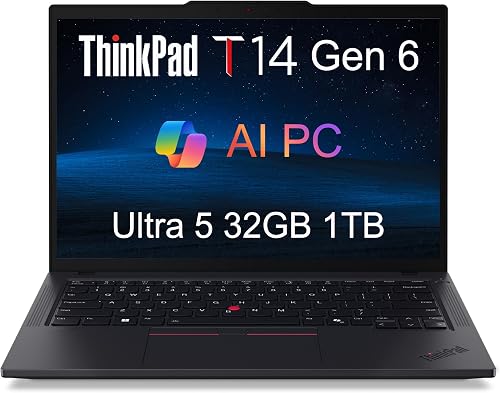
Lenovo ThinkPad T14 Gen 6 Laptop, Intel Ultra 5 225U, 32GB DDR5, 1TB SSD
It suits developers who run containers, virtual machines and many browser tabs at once. Two Thunderbolt 4 ports and HDMI can drive up to three external 4K monitors. The trade-off is a 400-nit IPS panel, which has less contrast than the sharpest screens here.

Dell XPS 13 9350 Laptop, 13.4" FHD+, Intel Ultra 7 256V, 16GB DDR5, 1TB SSD
It suits developers who code on the move and want a small, premium machine. Windows 11 Pro adds Hyper-V for virtual machines, and Wi-Fi 7 keeps remote sessions quick. The trade-off is the 13.4-inch screen, which shows fewer lines of code side by side.

Apple 2026 MacBook Air 15-inch Laptop with M5 chip: Built for, 15.3-inch Liquid Retina Display, 16GB Unified Memory, 512GB SSD
It suits developers who work in macOS and want room for an editor and terminal side by side. Up to 18 hours of battery life and a backlit Magic Keyboard help on long coding days. The trade-off is a 512GB SSD, which fills fast with simulators and project caches.

LG gram 14" Light Laptop, Intel Core Ultra 5 325, 32GB RAM, 512GB SSD
It suits students and developers who carry their laptop everywhere and need plenty of memory. It weighs 2.5 pounds and carries a 72Wh battery in a 0.67-inch frame. The trade-off is 350 nits of brightness, which looks dim outdoors.

ASUS Zenbook A14 Laptop 14" WUXGA OLED (100% DCI-P3
It suits web and cloud developers who want the lightest ultrabook here for travel. Two USB-C 4.0 ports, HDMI 2.1 and Windows 11 Pro cover most desk setups. The trade-off is the Snapdragon platform, so confirm your compilers and tools run on it first.

Lenovo Yoga Slim 7X Laptop 14" WUXGA OLED Touch (100% DCI-P3
It suits developers who sketch diagrams on screen and want three USB-C 4.0 ports at 40Gbps. Wi-Fi 7 and a 9.2MP IR camera help with remote standups and pairing sessions. The trade-off is a 6-core chip, which can slow large local builds.
In-Depth Reviews
1. How Much RAM Do You Need for Coding on an Ultrabook?
16GB handles an IDE, a browser and a local server for most web and scripting work. The Dell XPS 13 9350, the Apple MacBook Air 15 M5, the ASUS Zenbook A14 and the Lenovo Yoga Slim 7X each offer 16GB.
Choose 32GB if you run Docker containers, Android emulators or virtual machines. The Lenovo ThinkPad T14 Gen 6 and the LG gram 14 Laptop tie for the most memory in this guide at 32GB.
2. Should Developers Choose Windows on Intel, macOS or Snapdragon?
The Lenovo ThinkPad T14 Gen 6 and the Dell XPS 13 9350 use Intel chips, which suit you if your team builds on Windows. Both run Windows 11 Pro.
The Apple MacBook Air 15 M5 runs macOS, which suits Apple platform work. The ASUS Zenbook A14 and the Lenovo Yoga Slim 7X use Snapdragon chips, so check that your languages and tools support those chips first.
3. Lenovo ThinkPad T14 Gen 6: Best Overall
The Lenovo ThinkPad T14 Gen 6 has an Intel Core Ultra 5 225U with 12 cores, 32GB of DDR5 RAM and a 1TB NVMe SSD, with a 14-inch 1920x1200 IPS screen. It suits developers who run containers, virtual machines and many browser tabs at once. Two Thunderbolt 4 ports and HDMI can drive up to three external 4K monitors. The trade-off is a 400-nit IPS panel, which has less contrast than the sharpest screens here.
4. Dell XPS 13 9350: Best Compact Pick
The Dell XPS 13 9350 has an Intel Core Ultra 7 256V with 8 cores, 16GB of DDR5 RAM and a 1TB PCIe SSD, with a 13.4-inch FHD+ screen at 120Hz. It suits developers who code on the move and want a small, premium machine. Windows 11 Pro adds Hyper-V for virtual machines, and Wi-Fi 7 keeps remote sessions quick. The trade-off is the 13.4-inch screen, which shows fewer lines of code side by side.
5. Apple MacBook Air 15 M5: Best Big Screen Pick
The Apple MacBook Air 15 M5 has an Apple M5 chip with a 10-core CPU, 16GB of unified memory and a 512GB SSD, with a 15.3-inch Liquid Retina display. It suits developers who work in macOS and want room for an editor and terminal side by side. Up to 18 hours of battery life and a backlit Magic Keyboard help on long coding days. The trade-off is a 512GB SSD, which fills fast with simulators and project caches.
6. LG gram 14 Laptop: Best Durable Pick
The LG gram 14 Laptop has an Intel Core Ultra 5 325, 32GB of RAM and a 512GB SSD, with a 14-inch IPS anti-glare screen. It suits students and developers who carry their laptop everywhere and need plenty of memory. It weighs 2.5 pounds and carries a 72Wh battery in a 0.67-inch frame. The trade-off is 350 nits of brightness, which looks dim outdoors.
7. ASUS Zenbook A14: Best Portable Pick
The ASUS Zenbook A14 has a Qualcomm Snapdragon X Plus with 8 cores, 16GB of DDR5 RAM and a 512GB SSD, with a 14-inch 1920x1200 OLED screen. It suits web and cloud developers who want the lightest ultrabook here for travel. Two USB-C 4.0 ports, HDMI 2.1 and Windows 11 Pro cover most desk setups. The trade-off is the Snapdragon platform, so confirm your compilers and tools run on it first.
8. Lenovo Yoga Slim 7X: Best OLED Touch Pick
The Lenovo Yoga Slim 7X has a Qualcomm Snapdragon X2 Plus with 6 cores, 16GB of RAM and a 512GB SSD, with a 14-inch 1920x1200 OLED touchscreen. It suits developers who sketch diagrams on screen and want three USB-C 4.0 ports at 40Gbps. Wi-Fi 7 and a 9.2MP IR camera help with remote standups and pairing sessions. The trade-off is a 6-core chip, which can slow large local builds.
How to Choose an Ultrabook for Programming
Memory
Get 16GB at minimum, and 32GB if you run containers or virtual machines.
Screen
A taller 1920x1200 screen shows more lines of code than a wide 1920x1080 panel.
Keyboard
Look for a backlit keyboard that stays comfortable through long coding sessions.
Ports
Thunderbolt 4 or USB-C 4.0 ports let you add monitors for a multi-window setup.
Quick Setup Tips
- Test your toolchain: Confirm your languages, compilers and IDE support the chip before you buy.
- Add a monitor: A second screen at your desk speeds up code review and debugging.
- Push code daily: Keep your repos on a remote Git host so a lost laptop never costs you work.
- Mind the keys: Try the keyboard layout in person if you rely on function key shortcuts.
- Check the live price: use the buttons to see the current price on Amazon
Frequently Asked Questions
What is the best ultrabook for programming?
The Lenovo ThinkPad T14 Gen 6 is the top pick, with 32GB of DDR5 RAM, a 1TB SSD and a 3.1-pound build.
Which pick is the lightest?
The ASUS Zenbook A14 is the lightest pick at 2.4 pounds.
Is a MacBook good for programming?
Yes, especially for macOS work. The Apple MacBook Air 15 M5 pairs an M5 chip with 16GB of unified memory and a 15.3-inch display.
Which pick has the smallest screen?
The Dell XPS 13 9350 has the smallest screen here at 13.4 inches.
Do you need a dedicated GPU for coding?
Most coding runs on the CPU and memory, so integrated graphics work well. The LG gram 14 Laptop pairs integrated graphics with 32GB of RAM.
The Bottom Line
The best ultrabook for programming pick for most shoppers is the Lenovo ThinkPad T14 Gen 6, with 32GB of DDR5 RAM and a 1TB SSD. For a smaller build choose the Dell XPS 13 9350, or pick the Apple MacBook Air 15 M5 for macOS and a 15.3-inch display.